Every product owner wants to make sure their team’s work contributes to the overall success of their business. After all, what would come from a bunch of software projects that don’t convey successful planning, execution, or evaluation?
That’s why every web developer and their cousin knows about the many types of project management methodologies.
For today, we’ll focus on just two of them – agile vs waterfall.
What Is Agile Project Management?
Let’s kick things off with agile project management.
Agile project management takes an incremental, iterative approach to managing software development projects. It’s a project management methodology that values consistent streams of user feedback to fuel continuous improvements.
You may read “continuous improvements” and dread the additional workload, especially if you’re working on complex projects.
But trust us, it’s worth it.
Modern businesses – and customers, for that matter – require rapid responses and adjustments to accommodate their fluctuating needs.
Agile is perfect for this, thanks to the flexible nature of its iterative development. It allows development teams to break down a project lifecycle into more minor phases, making development processes easily repeatable.
So, if you are to adopt the agile methodology, you should expect to become very familiar with design sprints.
Agile Methodologies You Need To Know
Before we shift focus to waterfall project management, there’s more you need to know about agile methodologies.
Yes, plural.
There are three main frameworks you need to know about when adopting the agile methods of development, such as:
- Scrum
- Kanban
- Lean
So, let’s take a closer look at each one.
1. Scrum
Scrum is a project management framework that utilizes a series of meetings, events, tools, and roles to deliver projects efficiently. It allows development teams to work within strict project timelines to complete specific tasks, usually via design sprints. We told you that you would get familiar with sprints.
The purpose of these sprints is for teams to create something valuable that will be included in the finalized product.
Usually, the Scrum process starts with sprint planning. Using artifacts like product backlogs, teams will determine how to achieve their objectives.
Then, teams will attend daily Scrum meetings. They’ll discuss the tasks and any problems or obstacles. From there, they will conduct sprint reviews to find out what worked and what didn’t.
Sprint retrospectives follow sprint reviews, allowing teams to reflect on previous sprints to inform future ones. This cycle is iterative, so once one sprint finishes, another one starts with the next top priority from the backlog.
2. Kanban
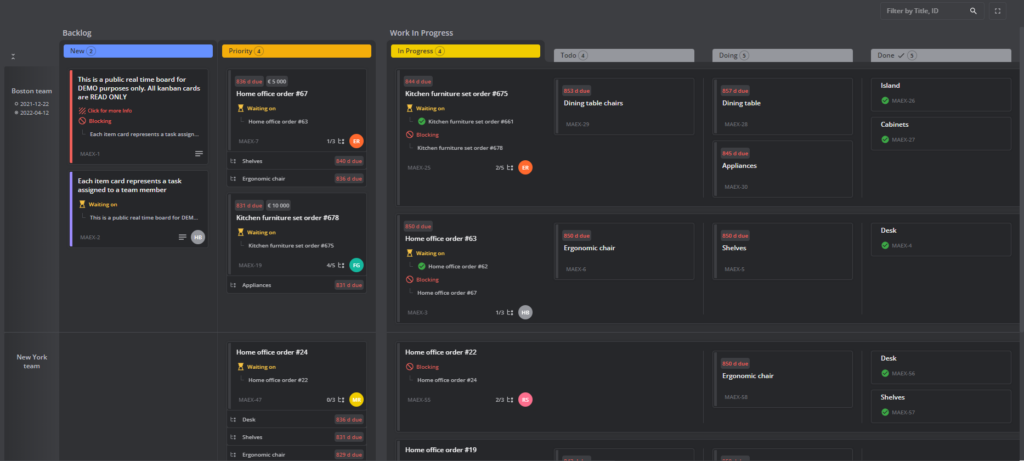
Kanban is an agile method that relies on Kanban boards, which are simply visual project management systems. Pulling priorities from the product backlog, a Kanban board will transform these items into visual, easy-to-follow workflows.
In a Kanban board, these ‘items’ or tasks appear as cards that you can move into different columns. It sounds a bit like card sorting, right?
But in the case of Kanbans, you aren’t moving the cards as part of a test. You’re moving the cards into different columns to indicate your progression through each individual task. Kanban boards are great for seeing what your team is prioritizing and working on.
For you, Kanban boards have everything you need to manage your workload and flow.
3. Lean
Picture your typical workday. You’re working at your desk. In a strange turn of events, a mass of office supplies clutters your workspace. It’s messy and distracting, and you can’t focus on your work because you can’t move without covering yourself in sticky notes.
You remove the office supplies – eliminating the distractions and ridding your workspace of things you don’t need. Now, you can organize your workspace and focus your efforts on productivity more efficiently and effectively.
That’s essentially what Lean development is. Lean focuses on reducing waste and using minimal resources to improve efficient workflows while never compromising high-quality work.
These three agile frameworks show the values of agile management: efficiency, high quality, and iteration.
The Waterfall Project Management
Now let’s focus on the other side of the waterfall vs agile debate – waterfall project management.
What Is the Waterfall Method?
It’s actually quite the opposite of agile development methods.
The waterfall methodology adopts a linear, sequential approach to project management. This approach flows like – you guessed it – a waterfall, progressing through all distinct phases within a project.
With waterfall models, you can’t progress to the next phase until you have completely finished the current phase you’re on.
Given all of this talk of phases, why not explore them further?
Understanding the waterfall method will make it easier to get your head around the waterfall process vs. agile process debate.
The Phases of the Waterfall Process
The waterfall process consists of five steps:
- Project requirements
- Design
- Implementation
- Verification and testing
- Maintenance
You’ll start by gathering the customer’s requirements – you need to know what the system should do, right? These written requirements will contain details for each stage of the project, including costs, Time to Market (TTM), and resources.
After gathering the project’s requirements, designers will develop and design solutions that meet those requirements.
But developers need something tangible. So, designers will produce physical deliverables that need approval and finalization.
If everyone is happy with the deliverables, it’s then time to implement the solutions. This is where developers take over and bring a UI/UX designer’s vision to life.
After developers finish coding the designs, you’ve got yourself a fully functional product on your hands.
From here, the team will verify and test the product to ensure it meets the specs. The product must also exhibit high quality and provide exceptional customer experiences.
Last, the product enters the maintenance phase after its release. This gives customers the chance to flag any bugs or change requests. Afterward, the team will address these requests and release newer, updated versions of the product.

Waterfall Methodology vs Agile Methodology: Key Differences
Let’s get to the good bit. The waterfall methodology vs the agile methodology differences. We have listed some of them below.
- The waterfall model is more traditional and sticks to its linear workflows, whereas agile celebrates rapid iteration.
- The waterfall methodology works best when teams can work with defined requirements. The agile methodology is best for projects whose requirements are likely to change.
- Agile is flexible enough to “course correct”, while changes in the waterfall method can prove slow and costly.
- The agile method requires frequent input from stakeholders. With the waterfall method, you establish goals and outcomes from the start, allowing stakeholders to take a step back.
- Waterfall has a fixed timeline; the agile schedule adapts as the project progresses.
- Generally, projects that use the waterfall model have a fixed budget; budgets are more flexible with agile methods.
- Waterfall projects take longer because everyone must agree on the project requirements before development begins. Agile projects, by comparison, are much faster, thanks to their iterative development cycles.
- Agile celebrates incremental testing to resolve issues that occur throughout the development process. With waterfall methods, you conduct testing at specific milestones.
- Agile allows for shorter project lifecycles as each iteration results in a functional product, leading to quicker product deliveries. Waterfall takes a slower approach to product delivery since you must complete every task prior to a product’s release.
- Waterfall methods require lots of detailed documentation to ensure that everyone on the team understands the project’s requirements. Agile methods don’t need as many documents because they encourage self-organization and collaboration.
When To Use Waterfall vs Agile Methodologies
Knowing the differences between the two methodologies is crucial; there is no arguing that. But if you really want to use them successfully, you need to know when to use waterfall vs agile methods.
In other words, the types of projects you work on will determine which method is best for you.
The waterfall method is best for projects that have well-defined requirements, inflexible timelines, and not much complexity. If your client’s demands are specific or you can’t foresee any major changes to the project’s scope, opt for waterfall.
Essentially, the stricter and more predictable a project is, the clearer it is that you should use sequential management methods.
Like waterfall projects, it’s also simple to determine when you should sidestep the linear approach in favor of agile methods. If your project’s end goals are unclear, complex, or subject to change, you know that you’ll need the agile methodology.
Additionally, if a project’s timeline is so strict that you can hear the ticking clock, agile is the way forward. It’s not a bad idea to use agile methods if you work with teams that need to collaborate frequently, either.

What Is the Difference Between Waterfall vs Agile vs Scrum?
Before we leave you to consider the methodologies discussed today, we need to answer one question first.
What is the difference between Waterfall vs Agile vs Scrum?
We already know what questions are popping into your mind right now. Given that Scrum is a framework within the agile methodology, is there even a distinct enough difference to note?
Simply put, yes, there is, and you need to know about it.
You know that agile management focuses on adaptive, iterative workflows, while waterfall management takes a sequential approach to product delivery.
Scrum, on the other hand, focuses on getting more work done much faster than other methods.
For that reason, three differences are unique to the Scrum framework – design sprints, Scrum masters, and burndown charts. Since we’ve already briefly touched on design sprints, we’ll go straight to Scrum masters.
Scrum masters bridge the gap between development teams and product owners. They’ll work with product owners to define the project’s requirements, and they’ll also work with development teams to plan sprints.
During sprints, these aptly named masters will help the team overcome any obstacles they encounter.
Unlike your typical project manager, Scrum masters will facilitate workflows rather than, you know, manage them.
As for burndown charts, they come into play during the sprints. Instead of visualizing completed tasks, burndown charts show teams the remaining tasks that they need to complete.
The best time to use the Scrum framework is if you want to produce deliverables at a quicker rate.
Agile vs Waterfall: Concluding Thoughts
Hopefully, you feel more confident about the agile project management vs waterfall project management matter. Ultimately, both methods have the same primary goal – to deliver projects and products efficiently and effectively.
As usual, the incentive to produce high-quality design solutions is to meet the needs and desires of target users. But to meet and exceed your users’ expectations, you’ll need more than methodologies and frameworks.
Enter Page Flows.
Page Flows provides all of the design inspiration you could ever need. Collecting 5,500+ user flow recordings and 89,000+ screenshots, we help our users optimize their users’ journeys. What’s more, brands like Disney, Vimeo, and Google reap the rewards of our resources.
From onboarding to general browsing, we help any brand – regardless of industry – create better customer experiences.
So, about that agile vs waterfall debate… whichever method you adopt, you’ll need design inspiration from Page Flows. Get started today to access the secret to compelling user flows and the latest design trends!